

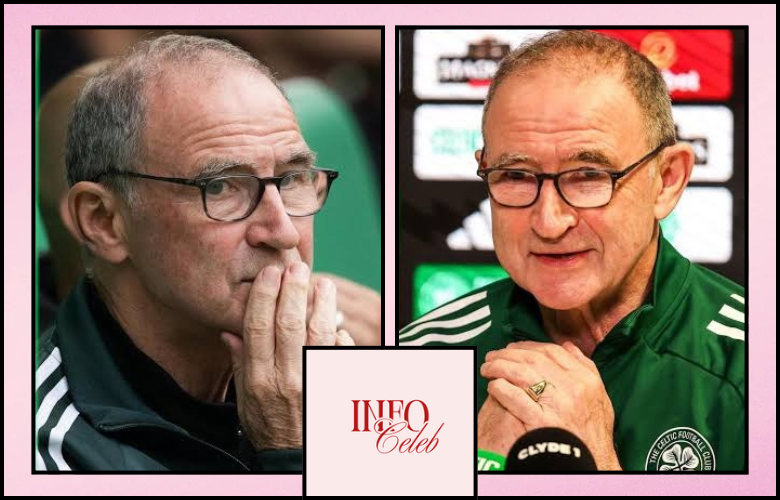
Watch Celtic Park on 16 May 2026 as a 74-year-old celebrates a league title most had given up hope of just a few months earlier. Celtic defeated Hearts 3-1 on the final day of the season; a third of the way through, Daizen Maeda scored three minutes before the end, and Callum Osmand completed the scoring a third of the way into stoppage time. For that elderly manager, Martin O’Neill, that was a fifth and the most unlikely of his five final achievements, only 16 years after he was first appointed at Celtic, as an emergency fix and then after a brief cruel flirtation with a young coach. This is how Martin O’Neill arrived at this moment, what his career means, and why people are still talking about him this autumn.
A Kilrea boy who ended up in Brian Clough’s side
Martin Hugh Michael O’Neill was born on 1 March 1952 in Kilrea, County Londonderry. Football was not his only sport. As a boy, he played Gaelic football with local clubs and with Derry at underage level. His footballing rise came with Distillery in the Irish League. Scored a couple of goals in a 3-0 win over Derry City in the 1971 Irish Cup final. Nottingham Forest saw him. Joined in October 1971, leaving Distillery and stopping the degree course.
Forest made the man. He went on to lift the First Division title in 1977-78 and lift the European Cup on two occasions, 1979 and 1980. That was the Clough years – and O’Neill was one of just a handful of players to leap second division football to European triumph.
He was equally a star on the international stage. He was capped 64 times by Northern Ireland, for whom he played at the 1982 World Cup as captain. That tournament will be remembered mainly for one evening in Valencia, when Northern Ireland beat the hosts Spain.
The managerial years, from Wycombe to Ireland
O’Neill managed for enough years that it’s easy to lose track of all the stops he’s made. He managed Grantham Town, Wycombe Wanderers, Norwich City, Leicester City, Celtic, Aston Villa and Sunderland. Two periods are of note. Three League Cup finals at Leicester, won twice. Seven trophies and three league titles at Celtic from 2000 to 2005, as well as taking his side to the 2003 UEFA Cup final – where they were beaten by a Porto team led by, yes, Mourinho. It was a less happy time at Sunderland.
They sacked him in March 2013. Would anyone else have done better at Villa? He had enjoyed a different kind of success there. He came sixth in the Premier League for three successive seasons and played in the final of the League Cup in 2010. Next was the Republic of Ireland job, which he took on in late 2013, with Roy Keane as his No.2. Ireland qualified for Euro 2016, which included beating the world champions on the way, but O’Neill and Keane left after the team exited in the last 16.
World Cup? They didn’t even qualify for 2018, and O’Neill and Keane lost their jobs there. His previous club gig before this most recent spell was a short one. He was made Nottingham Forest boss in January 2019 but was sacked that June. His own story is told in the autobiography On Days Like These, which deals with the trophies and sackings with his usual candour and wit.
Why Martin O’Neill is back in the conversation
For a couple of seasons, it appeared that was that. But Celtic’s 2025-26 season dissolved, then suddenly was back on again in a way few scripts could possibly stretch to. Brendan Rodgers suddenly left in October, and O’Neill agreed to take the reins temporarily.
Revealing during his presentation that he hadn’t always enjoyed his previous stops because of the need to “win football matches”, he vowed to have fun this time around, and was seemingly on course to do so, having won seven of eight games in his brief first stint, before stepping aside for Wilfried Nancy in early December. Nancy didn’t hang around.
He was dismissed after eight matches, six of them defeats, following a 3-1 home loss to Rangers which led to protests by supporters outside Celtic Park. Celtic sat second in the table, six points behind Hearts, and O’Neill rejoined for the remainder of the campaign. This was the sequence of events that Celtic supporters will recount for decades to come.
Celtic concluded seven straight wins, having usurped Hearts’ 226-day reign at the summit. But there was also the matter of a 99th-minute penalty in the win over Motherwell days earlier that Hearts manager Derek McInnes branded as ‘disgusting’. Context is everything in this title-race narrative for anyone without a Hearts agenda.
The victory on the final day secured Celtic their fifth consecutive Premiership crown and a record 56th overall, one more than Rangers. Defender Alistair Johnston summed up their accomplishment: “O’Neill should have a statue.” A week later arrived the cup. Celtic won the final 3-1 against Dunfermline at Hampden with Maeda, Arne Engels and Kelechi Iheanacho scoring for them.
Just a lovely little twist in the opposite dugout in the shape of Dunfermline being led out by Neil Lennon, a key member of the best Celtic and Leicester sides managed by O’Neill. O’Neill ended up with nine major honours as Celtic boss in a 26-year link with the club.
Staying on, and a bumpy autumn
Few believed the Hampden game marked the end. In the build-up to the game, he was described as potentially his last in charge. However, Celtic appointed him permanent manager, and the 74-year-old signed a one-year deal with the club. Ex-Celtic player Stiliyan Petrov said he was surprised they hadn’t offered O’Neill a less stressful position, and the club reportedly discussed with Robbie Keane his potential successor.
It hasn’t been plain sailing. Celtic’s worst run for five years was a day, a week, and one game a week away – two setbacks at the hands of the team below, and a Europa League loss to Ferencvaros. O’Neill contemplated his future during the international break. No time was wasted deciding what he should do.
“I love the club, I want to manage them, and I want to win the league,” said the 51-year-old, as hungry as he was before. He even dismissed the hype surrounding the defeats. “They’re small margins, and it’s not world-ending.” Celtic should have played Hibernian on 25 October. That result is not listed here; check a live source for updates.
What explains the O’Neill effect?
It would be disingenuous to suggest a clean-cut formula, and the evidence does not lend itself to that either. What the reporting does reveal is a shared pattern: he enters a challenging environment, immediate results follow, and players sing his praises. Johnston’s tendency to claim he just finds a way to win is the most common take.
But O’Neill’s own story is less grandiose. ‘I look at myself first after a bad run’, he says, and remembers his playing career, when he would be a lot more prone to blaming teammates. That might be the secret of a 30-year management career. Only a handful of managers enjoy careers spanning three decades if they don’t learn to accept fault when the team suffers.
This does not even take into consideration the fact that his tale is rather comprehensive too. He is a European Cup-winning player, a cup-winning manager in England, a national team boss in a significant competition and a title-winning coach in Scotland – at three different points in his life. Plenty of footballers have a larger collection of trophies. Very few have a more diverse one.
Where Martin O’Neill goes from here
The honest answer is no one else outside the club has a clue. For there is one year left on the contract, he’s 74, and he’s being paid to try and defend two home titles. What is certain, however, is that Martin O’Neill has exceeded the initial expectations held for him when he picked up the phone last October.
Frequently Asked Questions (FAQS)
How Old Is Martin O’Neill?
He was born on 1 March 1952. Therefore, as of October 2026, he is 74 years old.
Is Martin O’Neill still Celtic manager?
According to the latest reports, yes. Martin O’Neill signed a permanent one-year deal at the end of the 2025-26 season, and in October he stated that he intended to remain in charge despite a string of poor results.
What has O’Neill won as a manager?
O’Neill previously led Leicester to the League Cup twice and managed Celtic in a period of Scottish dominance with three league titles and other domestic honours between 2000 and 2005. O’Neill more recently won the 2025-26 Scottish Premiership and Scottish Cup.
Was Martin O’Neill at Forest?
Yes. Martin O’Neill joined Nottingham Forest in 1971 before going on to win the First Division title and two European Cups.
Why did Brendan Rodgers leave Celtic?
Rodgers left the club abruptly in October 2025, and O’Neill took over. An official full account of why he left has not been published, as this is not explained in detail below.
